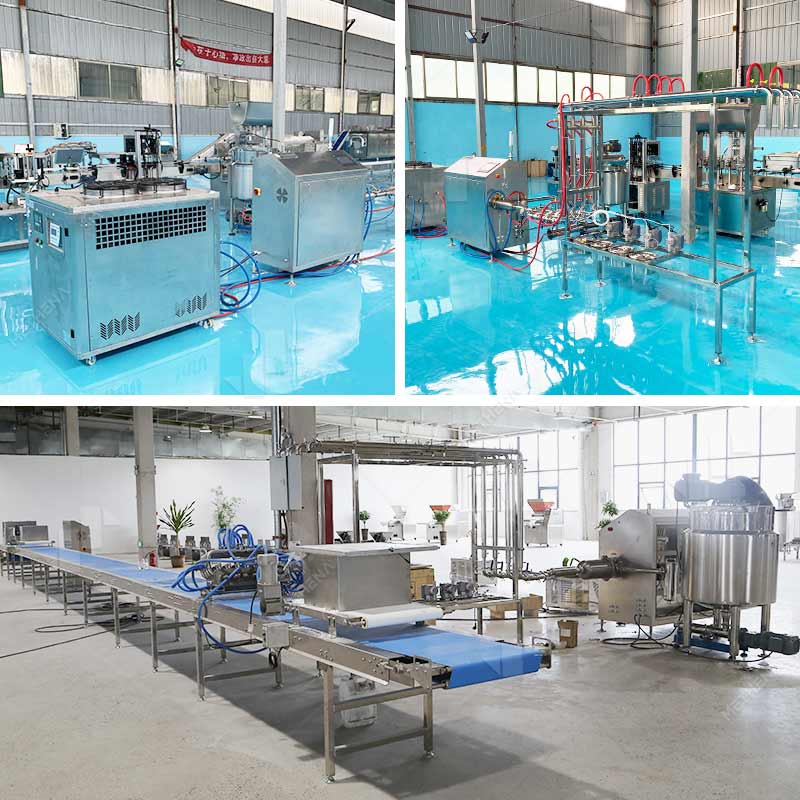
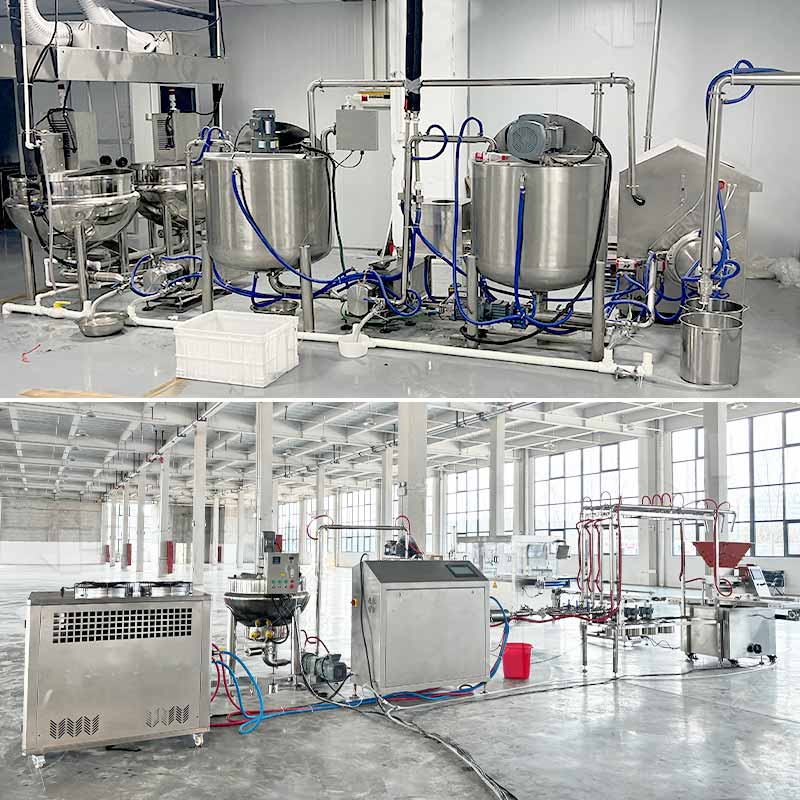
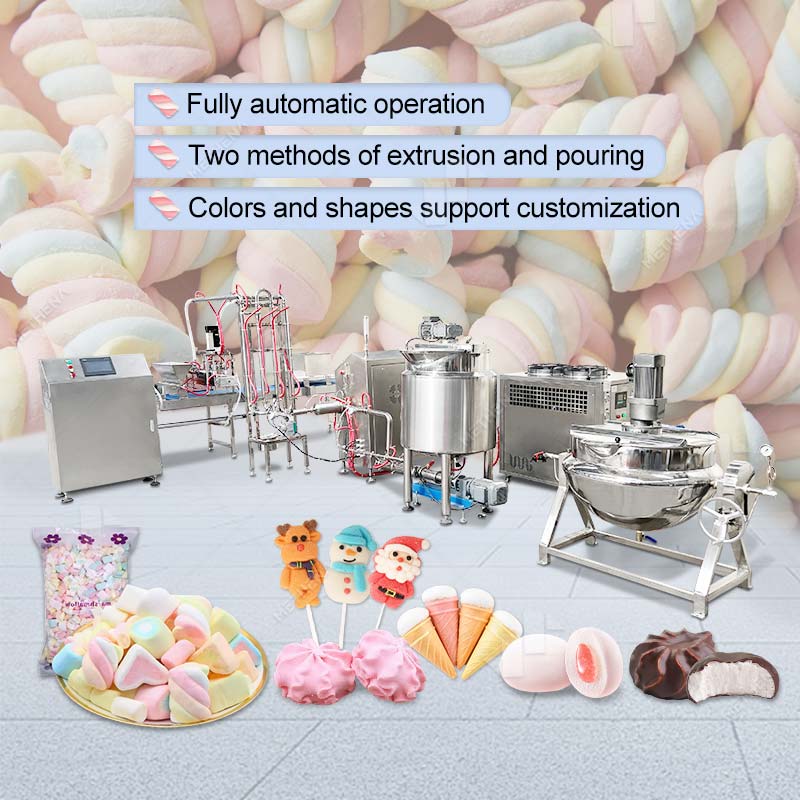
In the confectionery industry, marshmallow production has long faced numerous challenges, such as complex processes, high reliance on manual labor, and difficulty in maintaining consistent product quality. The fully automated marshmallow production line continuously processes syrup through cooking, heat preservation, high-speed stirring/aeration, shaping, cutting, and starch powder coating, automatically transforming raw materials into finished marshmallows of various shapes and sizes.
| Production Capacity | 100-150 kg/h |
| Total Power | 30 kW |
| Operating Voltage | 380V / 220V (optional) |
| Overall Dimensions (L×W×H) | 4800×1300×1600 mm |
| Machine Weight | 3000 kg |
| Material | Stainless Steel |
| Finished Product Shapes | Customizable (strip, square, watermelon, twisted, etc.) |
| Finished Product Colors | Customizable (single‑color / multi‑color) |
| Operators Required | 3‑4 persons |
| Certifications | ISO 9001, ISO 14001, ISO 45001, CE, BSCI, ETL |
| OEM/ODM Service | Acceptable |
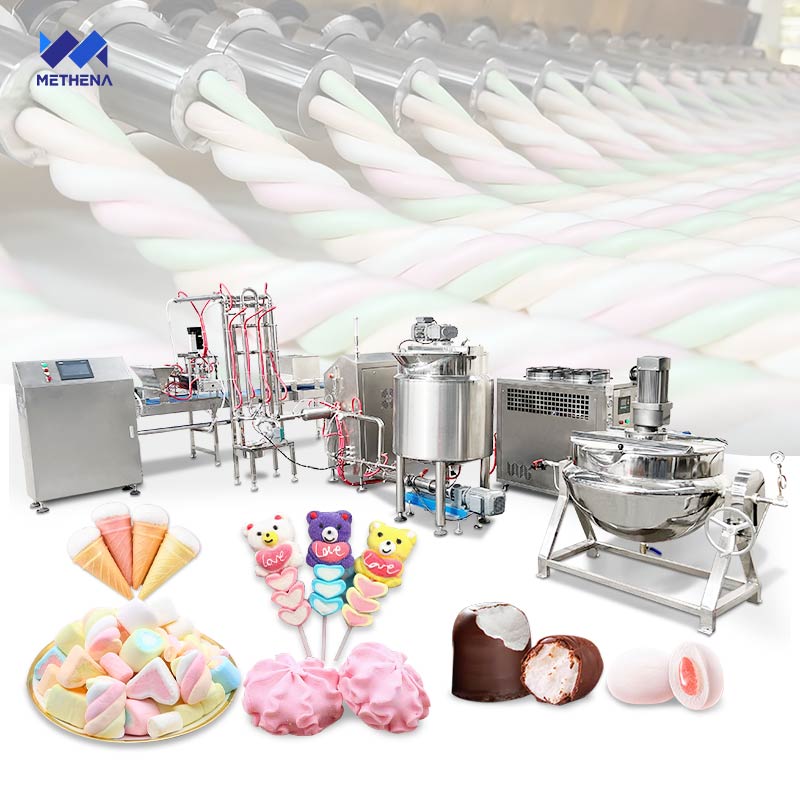
The Methena automatic marshmallow production line is a continuous confectionery processing system for candy factories, snack manufacturers, OEM producers and bakery ingredient suppliers. Its core value is not simply forming syrup into marshmallows. It connects syrup cooking, insulated transfer, continuous aeration, two-color extrusion, cooling, servo cutting, starch separation and packaging connection into a more controllable industrial workflow.
For marshmallow manufacturers, the real purpose of investing in a production line is to solve three production problems: stable syrup density, consistent product shape and reduced downtime when changing color, shape or recipe. The GD-150 automatic marshmallow production line has a reference capacity of 100-150kg/h and can be configured for single-color rope marshmallows, multi-color twisted marshmallows, square marshmallows, watermelon shapes, animal shapes, filled marshmallows and other customized products. With a rational machine layout, about 3-4 operators can manage the whole line, helping factories control labor pressure and batch variation as order volume grows.
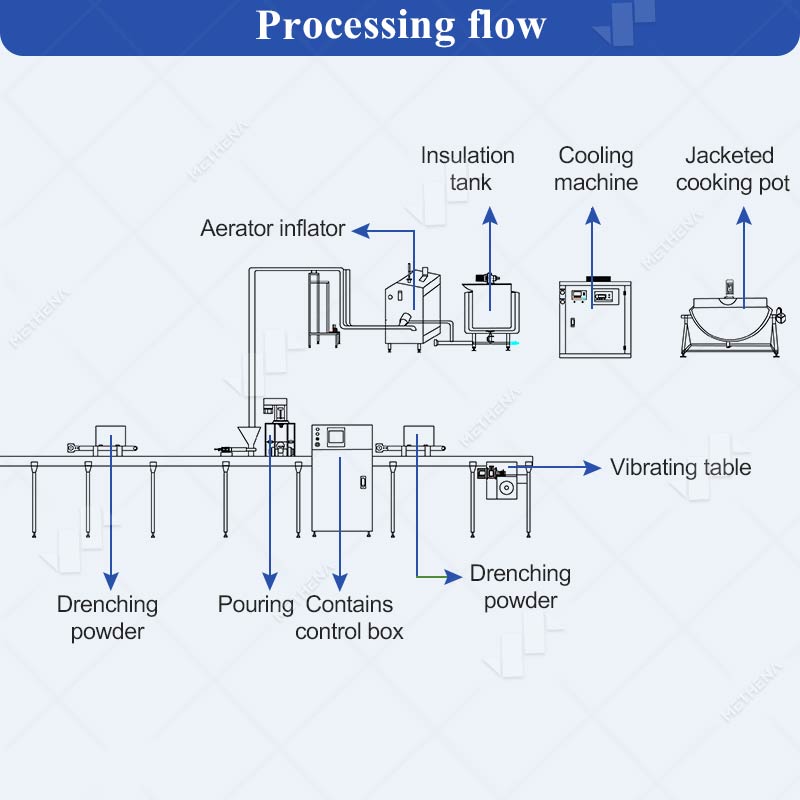
The automatic marshmallow production line operates on a systematic process route of "continuous aeration whipping + automatic forming + in‑line starch dusting," which can be broken down into six core stages:
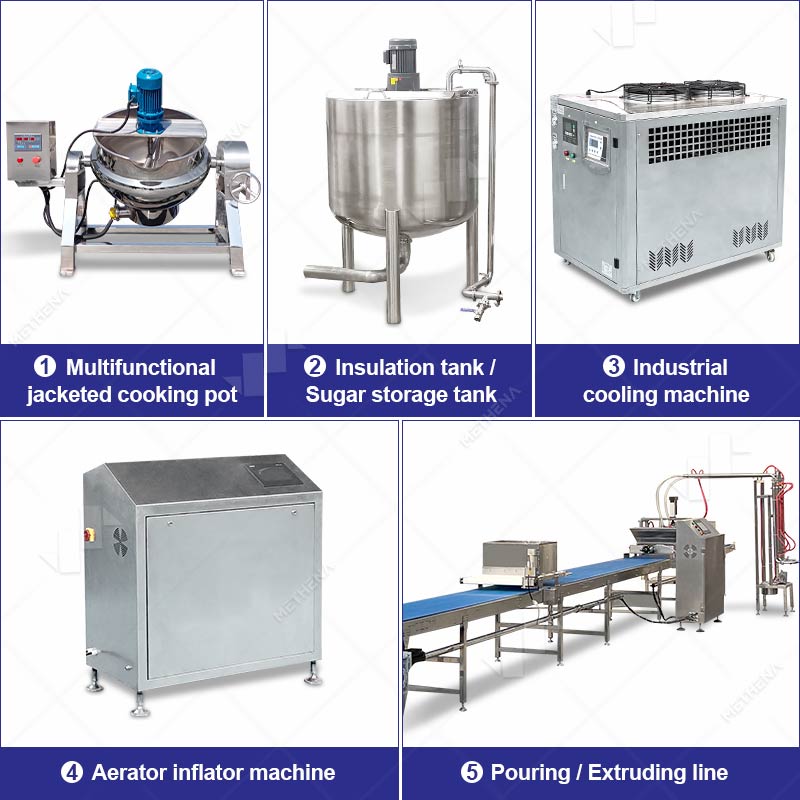
Syrup Cooking: Raw materials (white sugar, glucose syrup, water, etc.) are fed into the cooking kettle, where they are cooked using multiple heating methods (steam or electric heating). The kettle is equipped with pressure gauges, safety valves, steam traps, and agitators to precisely cook the ingredients into syrup that meets process specifications.
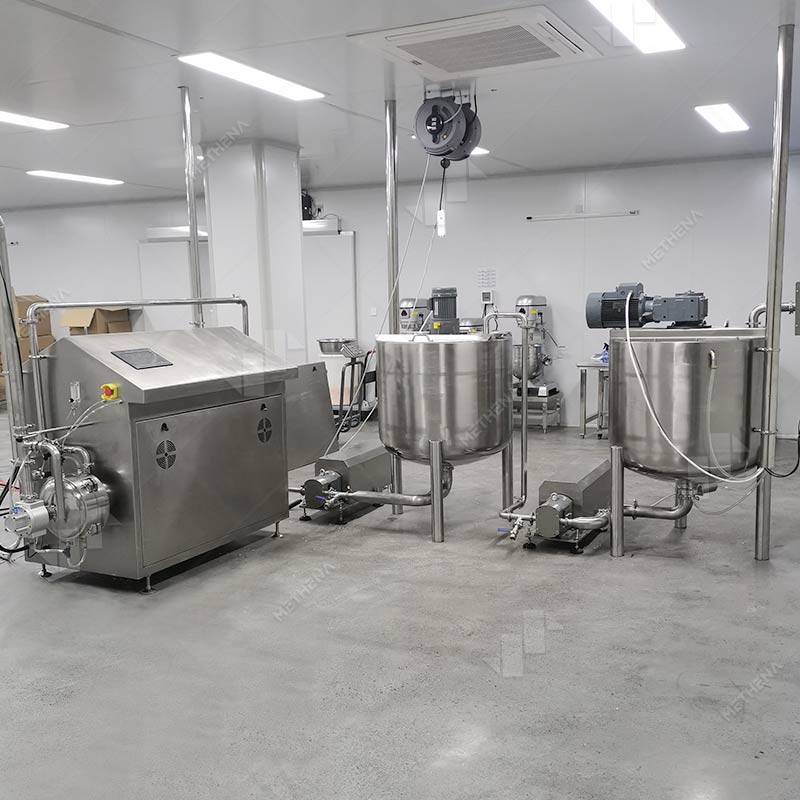
Syrup Holding & Storage: The cooked syrup enters an insulated holding tank with stirring function, where it is stored at a constant temperature. The holding function ensures the syrup maintains the optimal temperature, preventing solidification and providing a stable supply for the subsequent whipping stage.
High‑Speed Whipping/Aeration: This is the core process of marshmallow production. The syrup is fed into the whipping machine via automatic piping. Under high‑speed agitation and with the addition of foaming agents, the syrup is filled with fine, uniform air bubbles, forming a light, porous structure. The whipping density can be set with one touch via the intelligent control panel, ensuring consistent and repeatable aeration results.
Automatic Conveying & Color Changing: The whipped marshmallow slurry is conveyed automatically to the two‑color changing station. At this station, single‑color or multi‑color combinations can be applied according to product requirements.
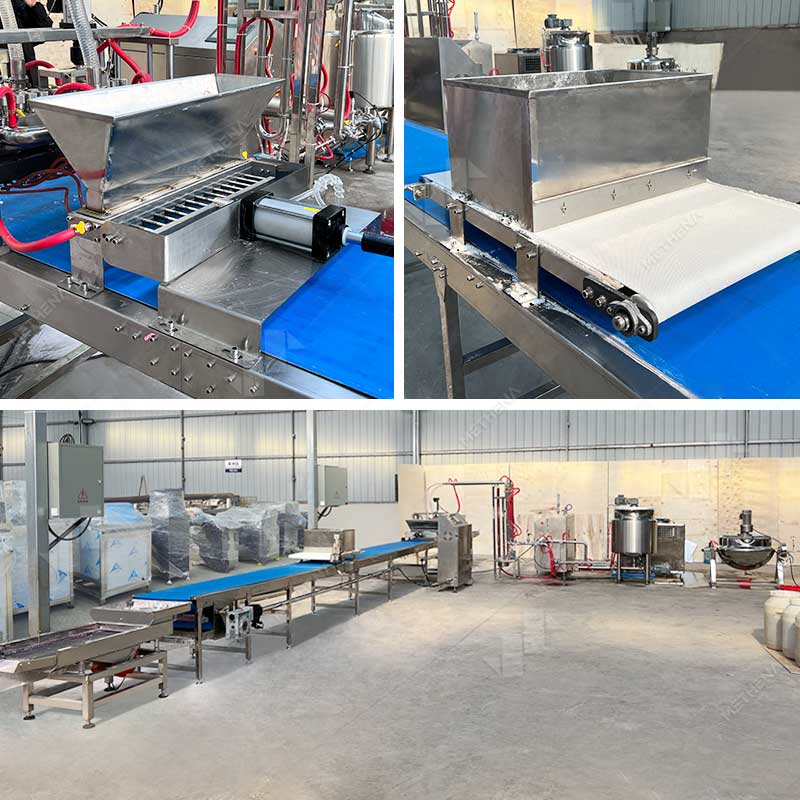
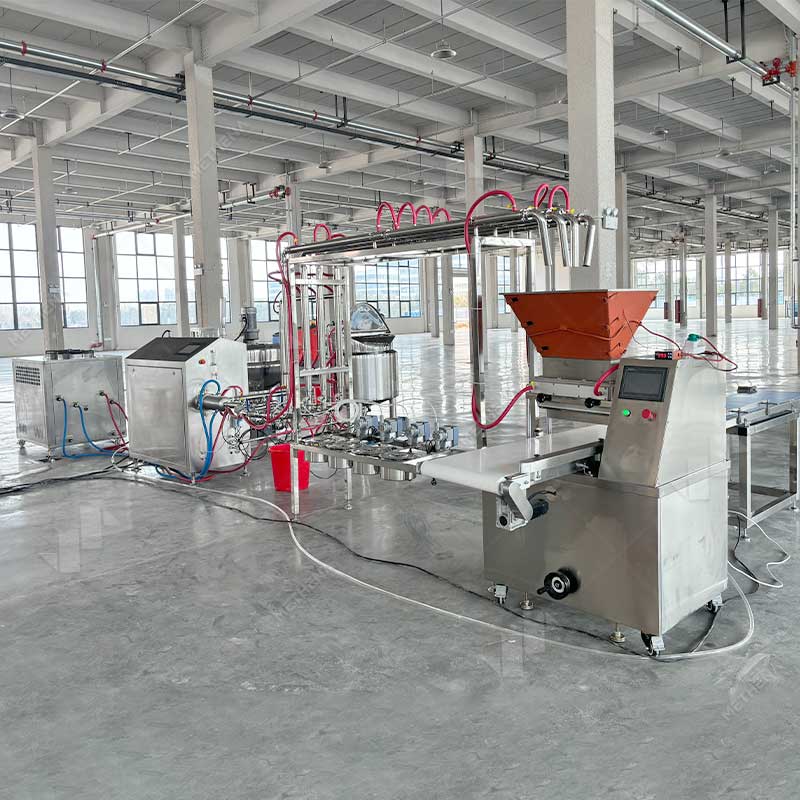
Forming & Cutting: The color‑adjusted slurry enters the forming machine through piping. The line supports both depositing (casting) and extrusion forming methods — depositing is suitable for filled products, chocolate‑coated items, etc.; extrusion is suitable for rope‑shaped, twisted, animal‑shaped, and other molded products. The continuous formed marshmallow string is automatically cut to customer‑specified lengths.
Starch Dusting & Output: The cut marshmallows are conveyed via an inclined elevator to a rotary drum starch duster. The starch dusting process removes excess surface starch, leaving a clean, non‑sticky surface, after which the finished product is ready for packaging.
Cooking Kettle (Raw Material Processing Core) : Multiple heating methods available, equipped with pressure gauges, safety valves, steam traps, and agitators to precisely cook raw materials into syrup. The kettle is made of stainless steel with uniform heating and controllable temperature.
Holding/Storage Tank (Intermediate Storage Core) : Equipped with stirring function, mainly used for storing and holding syrup at constant temperature. The insulated design prevents syrup solidification, ensuring a stable supply for the whipping stage.
Whipping Machine (Aeration Core) : Utilizes internationally advanced technology with one‑touch intelligent density setting. The high‑speed rotating whipping head completes aeration of the syrup in a short time, creating a fine, uniform foam structure.
Industrial Cooling Unit (Temperature Control Core) : Cold and hot water circulation system — hot water is used to insulate syrup in the piping to prevent solidification, while cold water cools the whipping head to prevent temperature rise during high‑speed operation that could affect whipping quality.
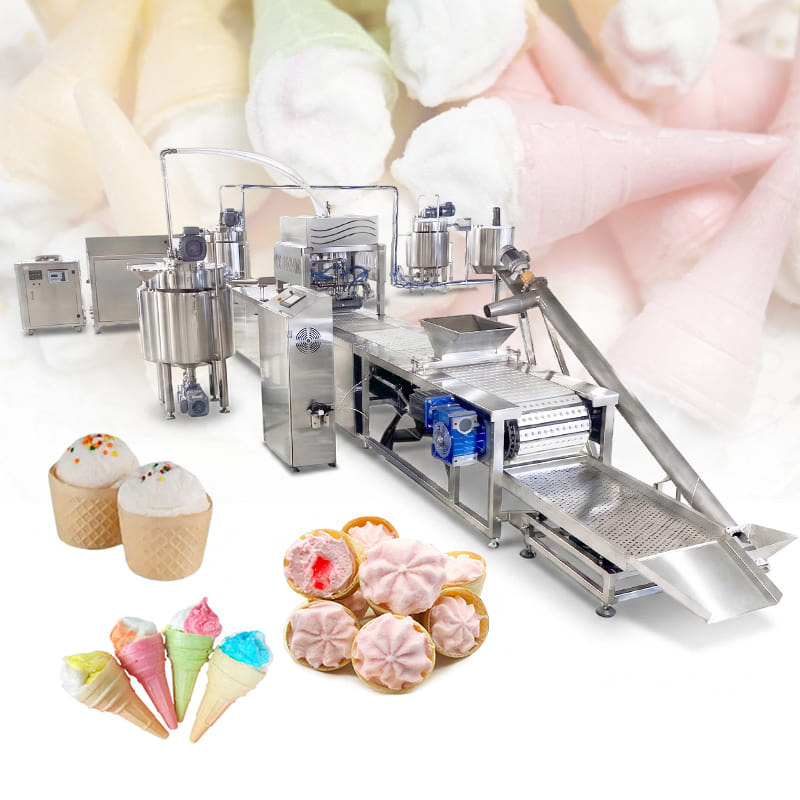
Depositing/Extrusion Forming Line (Forming Core) : Includes control cabinet, starch duster, depositor/extruder, vibrating table, and other equipment. Supports both depositing and extrusion forming methods for producing various marshmallow shapes.
Starch Duster (Post‑Processing Core) : Rotary drum design that removes excess surface starch, leaving a clean, non‑sticky product surface, delivering finished semi‑products ready for packaging.
1. Large‑Scale Confectionery Plants (Global)Typical Products: Two‑color strip marshmallows, square marshmallows, twisted marshmallows;Line Match: The GD‑150 model's 100‑150 kg/h capacity meets large‑scale production needs; fully automatic continuous operation significantly improves efficiency and reduces labor costs
2. Snack Food Manufacturers (Europe, Americas, Asia‑Pacific)Typical Products: Jam‑filled marshmallows, chocolate‑coated marshmallows, biscuit marshmallows;Line Match: Supports both depositing and extrusion forming; quick product changeover via mold and formulation adjustments
3. OEM/ODM Confectionery Contract Manufacturers (Global)Typical Needs: Custom production of marshmallows in various shapes, colors, and flavors for clients;Line Match: Flexible forming capabilities meet diverse customization needs; rapid changeover adapts to small‑batch, multi‑variety contract manufacturing
4. Export‑Oriented Confectionery Companies Typical Products: Various marshmallows meeting international standards;Line Match: Full stainless steel construction complies with international food hygiene standards; multiple international certifications (CE, ISO, etc.) facilitate export customs clearance
5. Confectionery R&D Centers of Large Food CorporationsTypical Needs: Process development and trial production of new flavors and shapes;Line Match: Intelligent control system enables precise parameter recording and replication; high process consistency between small‑scale trials and full‑scale production
What products can this marshmallow production line produce?
It can produce single-color rope marshmallows, multi-color twisted marshmallows, square marshmallows, watermelon-shaped marshmallows, animal-shaped marshmallows, filled marshmallows, two-color marshmallows, etc. Specific shapes need to be confirmed based on the molding method and mold design.
Does the production line support color and shape customization?
Yes. Color, shape, fixed-length cutting, extrusion form, and some filling options can all be customized according to customer needs. Providing samples or images of target products will allow for more accurate selection.
Why is continuous whipping important for marshmallow quality?
Continuous whipping affects the distribution and density of air bubbles within the marshmallow. A stable whipping state results in a more uniform marshmallow texture, reducing variations in weight, taste, and appearance between batches.
How are the drying temperature and moisture content of marshmallows controlled?
The drying temperature should generally not be too high; a mild condition of approximately 40℃ is recommended, and the drying time should be adjusted according to the product size. The finished product moisture content can be controlled according to product requirements, with a common reference range of 12-16%.
How to get an accurate quote?
Please provide your target production volume, product shape, color quantity, whether a filling is required, packaging method, voltage, workshop dimensions, and whether OEM/ODM customization is needed. Methena will recommend a configuration closer to your actual production needs based on this information.










 Request a Quote
 More Products