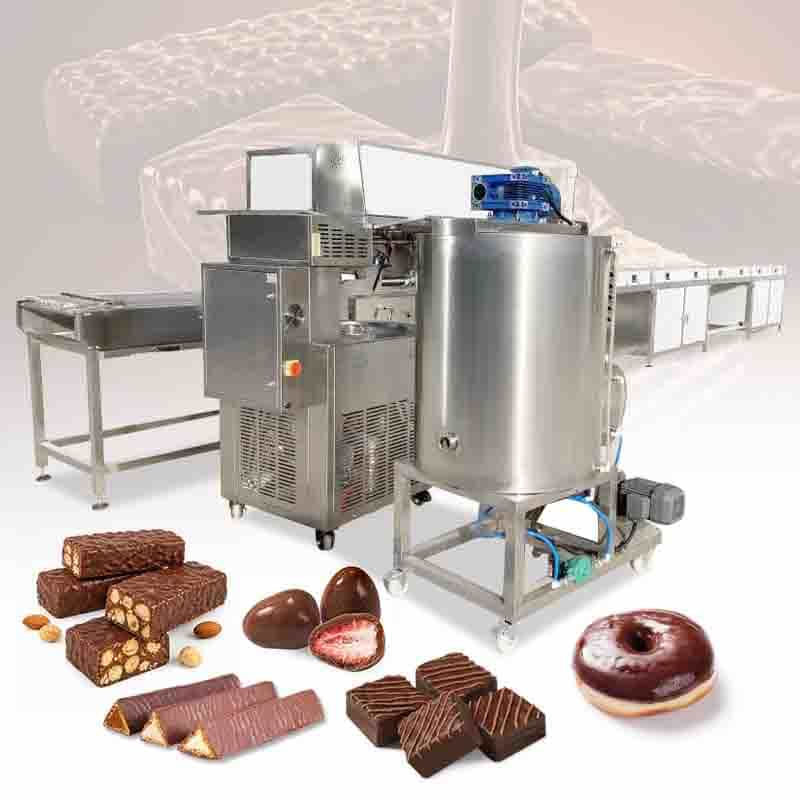
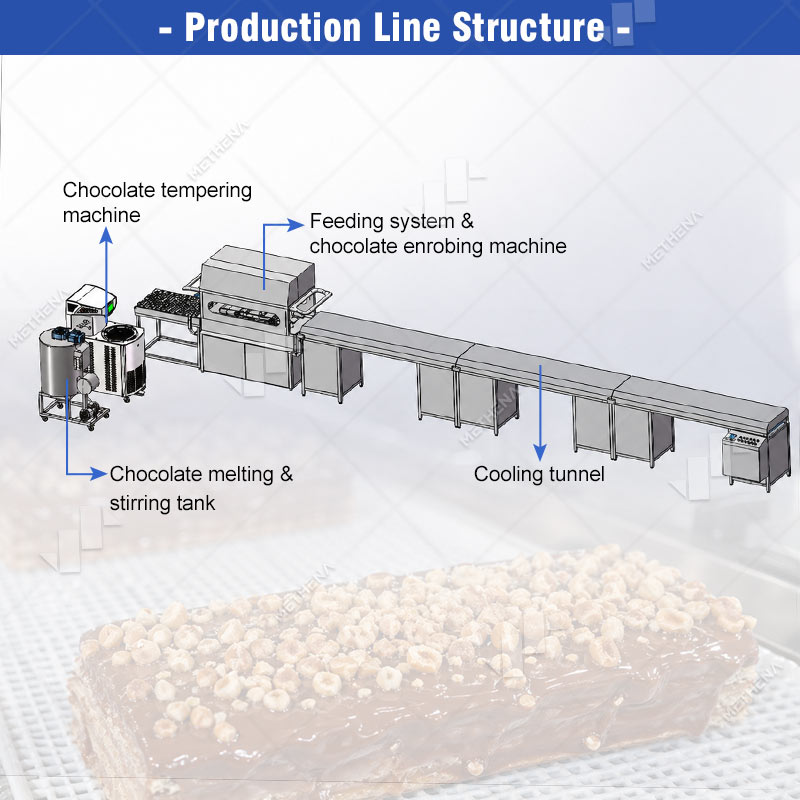
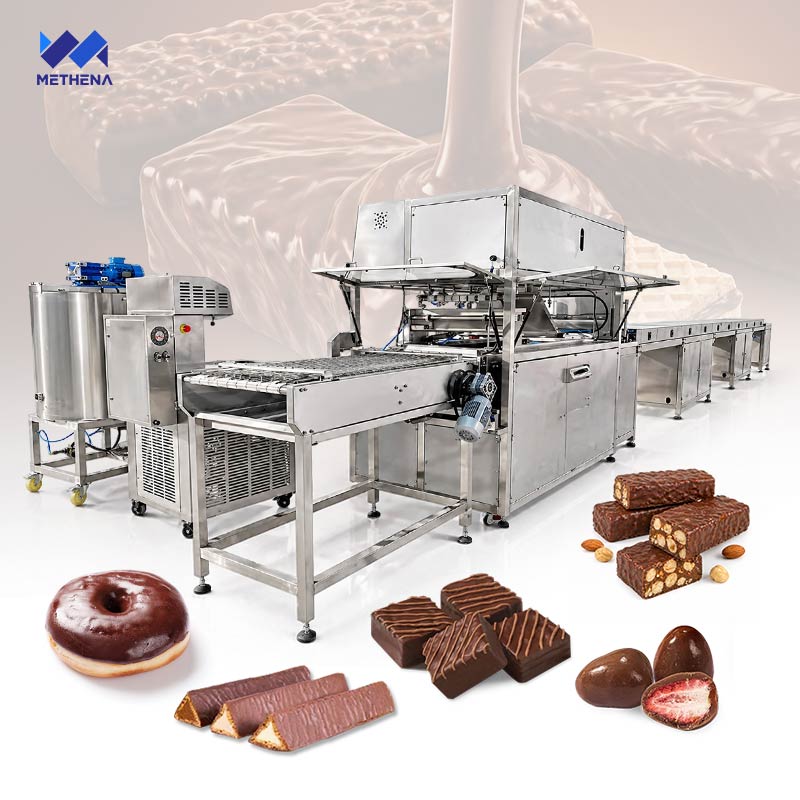
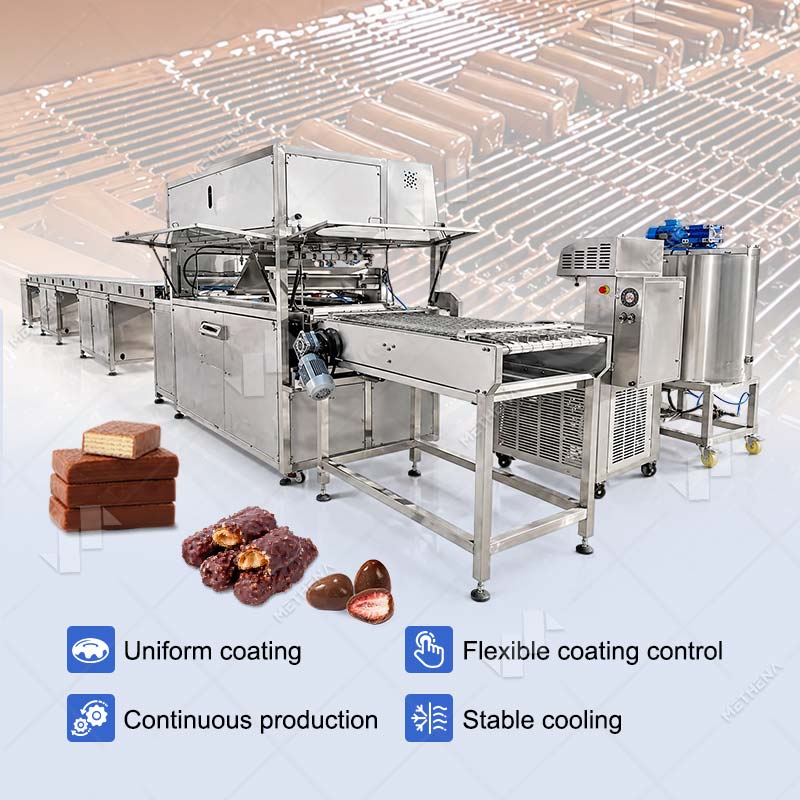
Methena’s fully automated chocolate coating production line is designed for food manufacturing facilities that require continuous chocolate coating processes. It is suitable for a wide range of products, including baked goods, snack foods, nuts, and freeze-dried fruits. The complete line consists of three main sections: a temperature-controlled chocolate holding tank, a waterfall-style enrobing machine, and a cooling tunnel. Products are transported on a food-grade conveyor belt, passing through a curtain of chocolate while being coated from below by a bottom-enrobing tray. They then enter the cooling tunnel to set, before proceeding to packaging or the next stage of the production process.
| Parameter | Representative Value / Range | Notes |
|---|---|---|
| Model (line) | HP-600 / HP-8000 configuration | Other configurations available |
| Conveyor speed | 3–15 m/min, variable frequency drive | Adjustable according to product and coating target |
| Heating method (enrober) | Electric heating | Jacketed water heating for chocolate circuit |
Methena's Chocolate Coating Line brings these operations together. Products travel along a conveyor through a chocolate enrobing section, where a pumped supply of melted chocolate forms a continuous curtain over the moving belt. Excess coating drains into the collection tray, while the coated products continue into the cooling tunnel for setting.
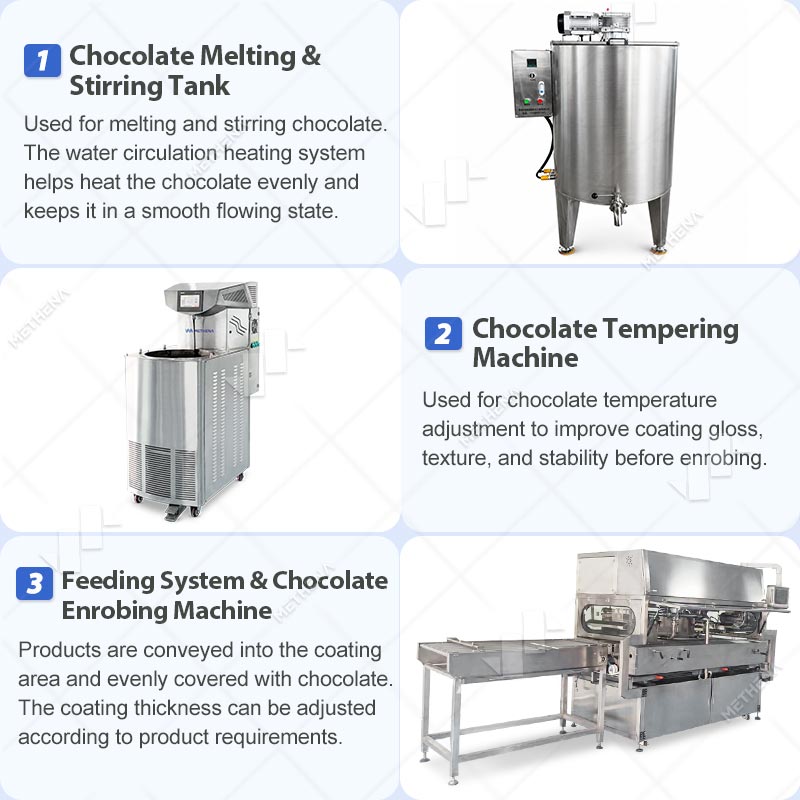
A typical line consists of a chocolate holding and mixing tank, an automatic enrobing machine and a cooling conveyor. Chocolate tempering equipment and a topping spreader can be added when the recipe calls for them. The arrangement is suitable for manufacturers producing chocolate-covered biscuits, wafers, cakes, snack bars and selected freeze-dried fruit products.
The HP-600 enrober configuration uses a 600 mm wire mesh conveyor with adjustable belt speed from 3 to 15 m/min. Its working width and conveyor arrangement make it suitable for continuous coating rather than individual hand-dipping. Actual production capacity will depend on the size, spacing and handling characteristics of the products.
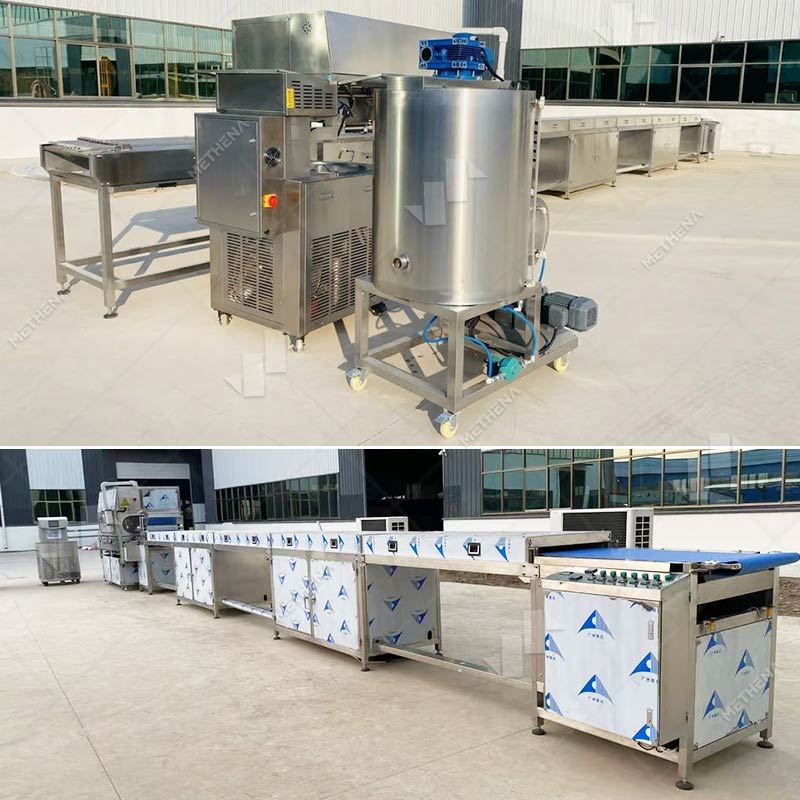
The following specifications describe one documented coating line arrangement using an HP-600 enrober and HP-8000 cooling conveyor. The 200L chocolate holding tank is a separate equipment option.
| Parameter | Specification |
|---|---|
| Model | HP-600 |
| Conveyor Width | 600 mm |
| Conveyor Speed | 3–15 m/min |
| Speed Adjustment | Variable-frequency control |
| Heating Method | Electric heating |
| Power | 10 kW |
| Voltage | 380 V |
| Machine Dimensions | 2300 × 1500 × 1400 mm |
| Material | Food-grade 304 stainless steel |
| Parameter | Specification |
|---|---|
| Tank Capacity | 200 L |
| Power | 8 kW |
| Dimensions | 1400 × 900 × 1700 mm |
| Material Inlet Height | 620 mm |
| Main Functions | Heating, mixing and chocolate supply |
| Parameter | Specification |
|---|---|
| Model | HP-8000 |
| Power | 10 kW |
| Dimensions | 8000 × 600 × 860 mm |
| Cooling Method | Refrigerated air cooling |
These figures refer to the documented equipment configuration, not to every possible coating line. Final electrical requirements, cooling equipment and production capacity should be confirmed against the selected layout.
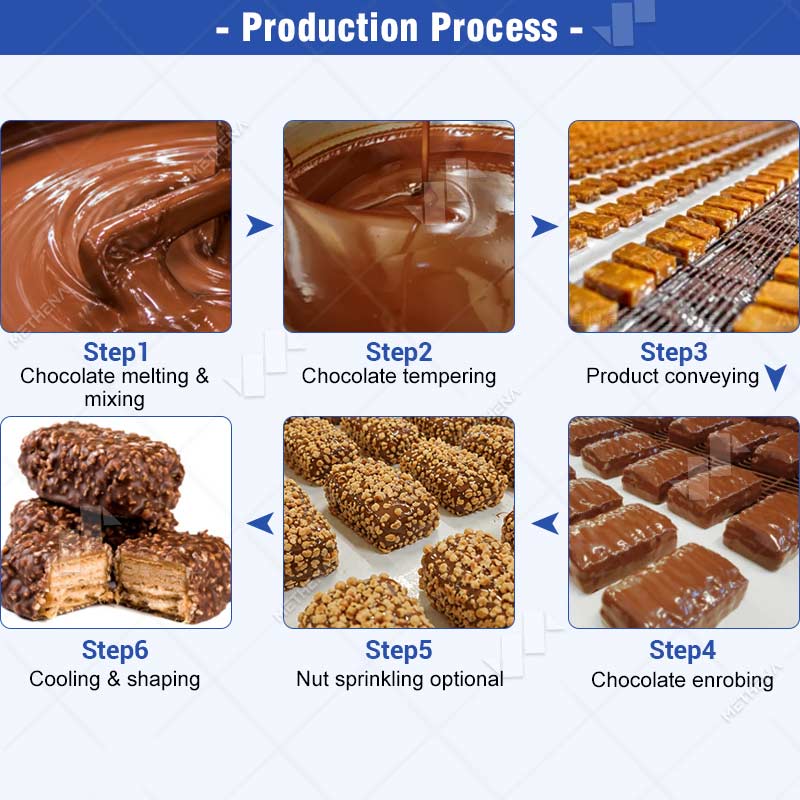
The process starts before the products reach the coating conveyor. Chocolate needs to be melted, kept at a suitable working temperature and supplied to the enrober without interruption.
Once the chocolate is ready, the coating and cooling sections operate as a continuous process.
Chocolate blocks or prepared chocolate mass are melted in a heated tank. The mixing system keeps the chocolate moving while the heating arrangement maintains a suitable processing temperature.
The documented holding tank uses a jacketed heating structure and an agitator. Its temperature-control arrangement helps prevent the chocolate from setting inside the tank during production.
For products made with real cocoa butter chocolate, tempering may be required before coating. A separate chocolate tempering machine can be incorporated upstream of the enrober. Compound coatings should be handled according to their own formulation and supplier instructions.
Biscuits, wafers, fruit pieces or other suitable products are arranged on the conveyor before entering the coating section.
A chocolate pump transfers the liquid coating from the holding reservoir to the overhead distribution system. The chocolate then falls across the moving wire mesh belt as a curtain.
As each product passes through, chocolate covers its exposed upper surface and flows around the sides. Depending on the coating setup, the underside can also receive chocolate through the lower coating arrangement.
Excess chocolate falls through the mesh into the collection tray below. The coating is circulated back through the system rather than relying on a new supply for every product.
This continuous flow is particularly useful when coating foods of similar size and shape over repeated production runs.
Freshly coated products leave the enrobing section with chocolate that is still soft.
They are carried directly into the cooling tunnel, where refrigerated air removes heat from the coating. The conveyor supports the products as the chocolate begins to set.
The cooling section is designed with upper air cooling and lower contact cooling arrangements. Its covered tunnel helps contain the cooled air, while the conveyor speed can be adjusted to suit the processing requirements.
The correct cooling conditions depend on the type of chocolate, coating thickness, product temperature and surrounding factory conditions.
After leaving the tunnel, the coated products can be collected or transferred to a suitable downstream conveyor or packaging system.
The coating should be sufficiently set before packaging to reduce sticking, surface marks and damage during handling.
For products that require an additional topping or decoration, the corresponding equipment can be positioned between the enrober and cooling tunnel.
A closed-loop chocolate circulation system ensures a consistent coating. The heated holding tank, pump, enrobing head, and bottom-coating tray form a continuous circuit. Chocolate remains in constant motion and under precise temperature control as it travels from the tank to the enrobing head, minimizing the risk of cold chocolate or settled solids entering the product stream.
The line supports both single-sided and double-sided coating. A bottom-coating tray allows for the application of chocolate to the underside of products, not just the top. Manufacturers producing fully enrobed items—such as biscuits or fruit pieces—can utilize double-sided coating, while those requiring a clean, uncoated base can configure the line for top-only coating.
Cooling capacity is matched to line speed. The cooling tunnel is sized in coordination with the conveyor belt speed, ensuring that the cooling zone provides the exact dwell time required for the product. This prevents common issues—such as an enrobing process that is too fast for the tunnel length—which would otherwise result in products still being tacky when they reach the discharge end.
Hygienic design facilitates easy cleaning. Components that come into contact with the product are constructed from 304 stainless steel, and the tunnel covers can be opened without the need for tools. The conveyor belt and bottom-coating tray are easily accessible for cleaning after production—a critical feature when switching between different types of chocolate, such as dark chocolate, milk chocolate, and compound coatings.
Production output is adjustable within the line’s operating range. The conveyor belt features variable-frequency drive (VFD) control, allowing for adjustments to both production throughput and coating weight without requiring mechanical modifications. The line can be operated at lower speeds for delicate products, or at higher speeds—within the limits of the cooling capacity—for more robust items.
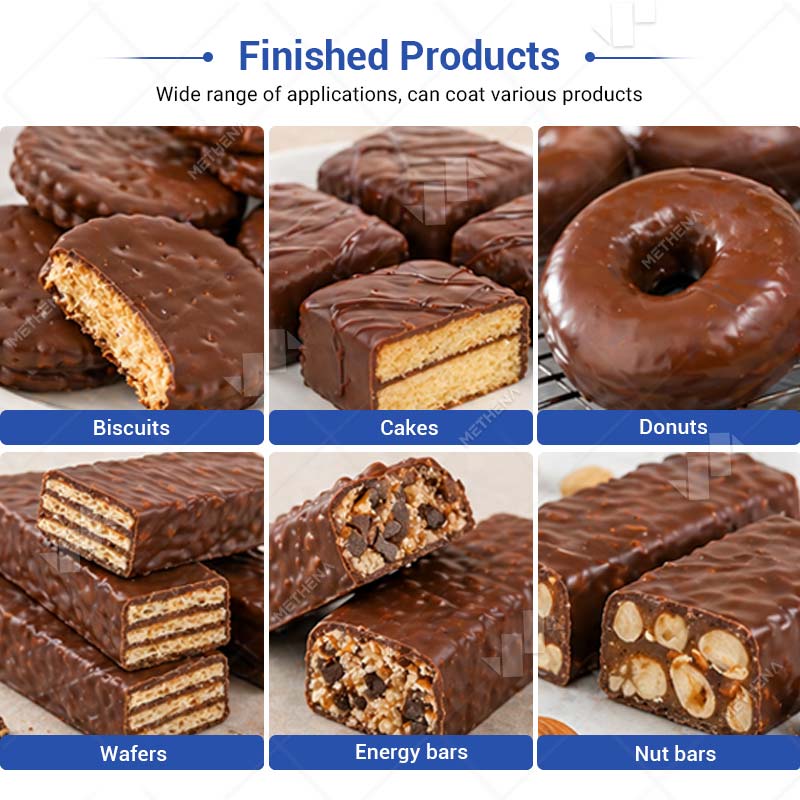
Biscuits and wafers: Fully coated (top and bottom) or single-side coated, depending on the product design.
Donuts and baked goods: Coated via a chocolate curtain, followed by cooling in a tunnel prior to packaging.
Freeze-dried fruits: Products such as strawberry, apple, or citrus pieces require a thin, uniform layer of chocolate to avoid excessive coating.
Nuts and nut clusters: Chocolate-coated almonds, peanuts, and mixed nut pieces.
Snack bars and confectionery blocks: Coated prior to packaging or secondary decoration.
Chocolate-coated yogurt bites and fruit slices: As demonstrated in product trial data, the production line can handle irregularly shaped pieces by adjusting the conveyor belt and curtain settings.
What types of products can be coated on this production line?
This line is suitable for products that can be placed on a wire mesh belt and passed beneath a chocolate curtain. Typical examples include biscuits, wafers, doughnuts, freeze-dried fruit pieces, nut clusters, snack bars, and irregularly shaped confectionery. Products that are too small (and would fall through the mesh) or too delicate to withstand the curtain require a different type of conveyor or coating method.
How should one choose between different models and configurations?
Start by considering product dimensions, target hourly output, and the desired coating weight per piece. The width of the conveyor belt determines how many products can be arranged across its surface, while the belt speed and cooling tunnel length dictate the amount of coating applied and the cooling time. The capacity of the holding tank should align with the hourly chocolate consumption rate. Once a supplier has this information, they can recommend an appropriate configuration.
What factors influence the actual production capacity (kg/h)?
Capacity is affected by product size and shape, target coating thickness, whether the coating is applied to one or both sides, conveyor speed, and the spacing of products on the belt. Even with the same belt width, the output in kg/h can vary significantly between different products due to differences in the amount of chocolate applied per piece and the number of items per meter of the belt. The line should be evaluated based on the specific operating rate for a given product, rather than relying on a generic capacity figure.
Does the production line require a separate tempering unit?
The holding tank maintains the chocolate’s temperature and ensures it is stirred, while the enrobing head applies the chocolate. If the product requires precise tempering to achieve the desired gloss and snap, a separate tempering unit may need to be installed upstream of the holding tank. Whether the tempering process is integrated into the line or provided as a standalone machine depends on the type of chocolate used and the requirements for the finished product.
Can the line coat both the top and bottom of the products?
Yes; this is achieved by incorporating a bottom-coating (enrobing) tray into the circulation loop. This allows for full coverage—coating both the top and bottom—for products that require it. For products that should remain uncoated on the bottom, the lower circuit can be configured to apply the coating only to the top.
Which parameters can be adjusted during production?
Key adjustable parameters include conveyor belt speed, holding tank temperature, agitation (stirring) speed, and the chocolate circulation flow. The conveyor belt speed simultaneously affects both the coating weight and the cooling dwell time. Temperature and agitation influence the viscosity and uniformity of the chocolate at the curtain.
Which components require regular cleaning, and how should they be cleaned?
Key areas requiring cleaning include the conveyor belt, the enrobing head (curtain applicator), the bottom tray, and the interior of the cooling tunnel. The tunnel covers can be opened without tools, allowing easy access to the cooling section. The chocolate circulation system should be flushed or cleaned based on the type of coating used and the product changeover schedule. Stainless steel contact parts are designed for easy cleaning.
What information is needed to obtain a configuration quote?
Please provide the product type and dimensions, target production capacity (kg/h or pieces/h), coating method (top-only or top-and-bottom), desired coating thickness, type of chocolate (real chocolate or compound/cocoa butter equivalent), available voltage, and any constraints related to your factory layout. If the production line needs to be integrated with existing infeed or outfeed conveyors, please also provide their respective heights and speeds. Based on this information, the supplier can propose the appropriate conveyor belt width, tunnel length, holding tank capacity, and electrical configuration.










 Request a Quote
 More Products